
March 14th — the day we celebrate the most famous number in mathematics. Grab a slice of pie and explore the infinite wonder of π.
My Pi Day Passion: Fun & Philanthropy
Pi Day is an event that I look forward to every year and is truly my favorite event of the year. I love seeing students dive into fun explorations, from digit memorization contests and pie-eating challenges to engineering pi-throwing machines and lively relay races.
But most importantly, this time of year marks the St. Jude Math-a-Thon for my classes, a special event where my students engage in service learning. They solve math problems and fundraise for St. Jude, ensuring no family ever receives a bill. St. Jude has help push childhood cancer survival rates from 20% to over 80% and the Math-a-Thon is a way for students to help support that mission. You can visit my schools fundraising page to see our progress or contribute, or learn more about the Math-a-Thon here.
What’s All the Fuss About Pi?
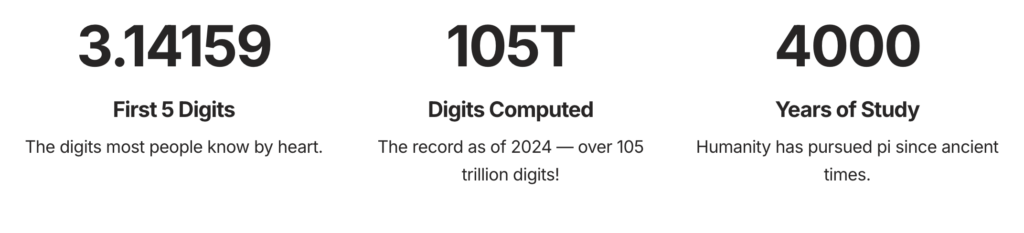
Pi (π) is more than just a number — it’s a fundamental constant that unlocks the secrets of circles and appears throughout science, engineering, and mathematics. For nearly 4,000 years, mathematicians have been fascinated by this irrational number, which begins 3.14159… and continues infinitely without repeating.
 Irrational
Never ends, never repeats — a decimal that goes on forever.
 Universal
Found in geometry, physics, statistics, and even music.
 Pi Day
Celebrated every March 14th (3/14) around the world.
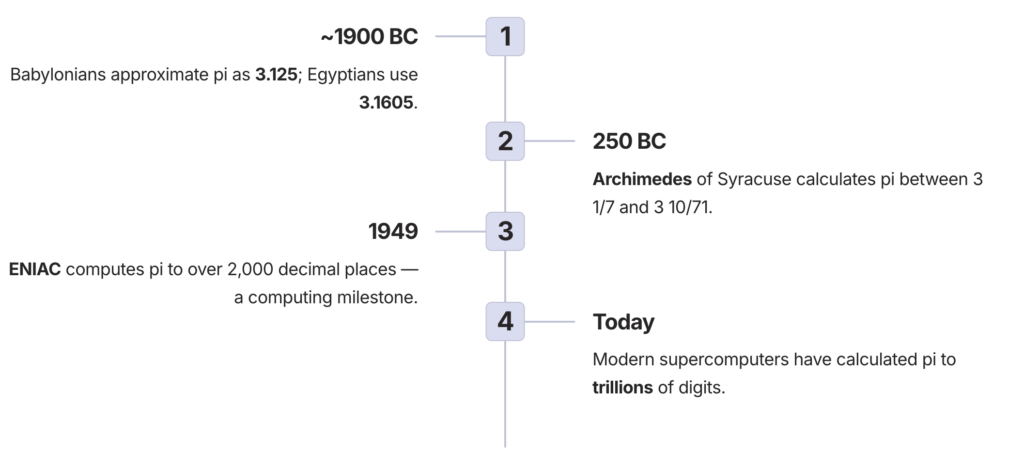
A Journey Through Pi’s History
The pursuit of pi spans ancient civilizations to modern supercomputers — a testament to humanity’s enduring mathematical curiosity.
Activity: Discovering Pi with Circles! 
In this hands-on experiment, students physically discover the relationship between a circle’s circumference and its diameter — arriving at pi themselves through measurement and division.
Materials Needed
- Various circular objects (plates, lids, cans, cups)
- String or yarn
- Scissors
- Rulers or measuring tapes
- A recording worksheet
Step-by-Step Instructions
- Measure Circumference: Wrap string around the edge of each object, mark where it meets, and cut it.
- Measure Diameter: Stretch string across the center of the circle and cut to that length.
- The Ratio: Lay circumference string against diameter string — notice it’s just over 3 diameters long!
- Calculate: Measure both strings with a ruler and divide circumference by diameter.
- Compare: Record results for each object — What do you notice about all
Activity: The Pi Puzzle Challenge 
A creative twist on the classic “Four Fours” puzzle — using only the digits 3, 1, and 4 exactly once per expression, build equations that equal every number from 1 to 30. Use any operations: +, −, ×, ÷, exponents, square roots, factorials, and parentheses.
 Objective
Explore pi’s digits through logic and mathematical creativity. How many numbers from 1 to 30 can you construct?
 Example: Making 1
(4 − 3) × 1 = 14 ÷ (3 + 1) = 1
Both use 3, 1, and 4 exactly once!
 Push Further
Try using factorials (3! = 6), concatenation (31 from 3 and 1), and nested square roots for harder targets.
NASA Receiver Riddle
In December 2023, NASA transmitted the first ultra-high-definition video from deep space using new technology known as Deep Space Optical Communications, or DSOC. DSOC uses an infrared laser to transmit data at a much higher rate than current radio transmitters. The 15-second video, featuring a cat chasing a laser, was beamed to Earth from the Psyche spacecraft at a rate faster than many terrestrial internet connections.
The Challenge
DSOC’s transmission had to travel 30,199,000 km to reach Earth. Even traveling at the speed of light, that takes a long time! And all that time, Earth was still moving along its orbit. That meant that the team needed to aim the laser transmission at where Earth would be when the signal arrived.
 Your Challenge
Determine how many kilometers ahead along Earth’s orbit did the team need to aim the laser?
Hint: Use pi to calculate Earth’s orbital circumference, then figure out how far Earth moves in the time it takes light to travel 30,199,000 km. (Things you’ll need to know: Speed of light; Earth’s orbital radius; and Earth’s orbital period)
Want to see the video NASA transmitted across space? Check it out below 
Beyond the Basics: Pi’s Infinite Nature
Pi is irrational — its decimal representation stretches on forever without repeating. This endless quality is what makes it endlessly fascinating. The quest to compute more digits has fueled breakthrough advances in algorithms and computing architecture. While no one will ever write down all of pi’s digits, its unwavering ratio is a cornerstone of geometry and science.
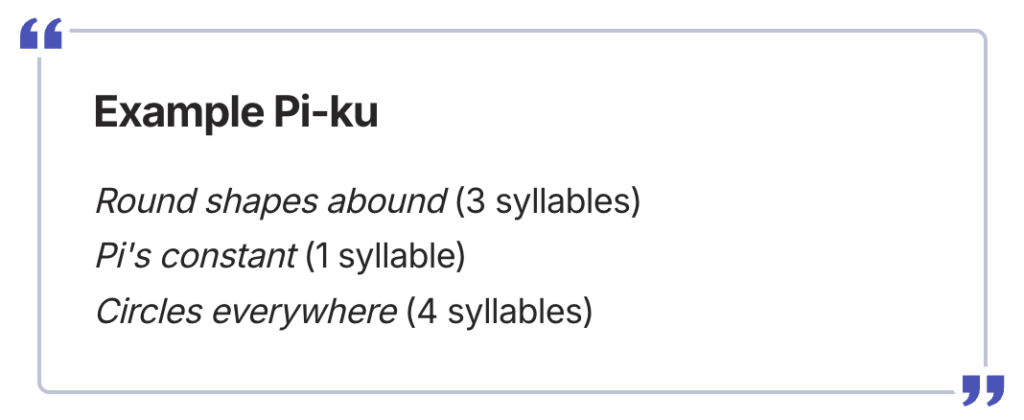
Pi-ku Poetry: A Syllabic Celebration ✍️
Inspired by the 5-7-5 syllable structure of a haiku, a “pi-ku” follows a 3-1-4 syllable pattern, mirroring the first three digits of pi. It’s a playful, creative way to connect mathematics and language arts — perfect for Pi Day!
Try writing your own pi-ku and share it with the class. The constraint of exactly 3, then 1, then 4 syllables makes it delightfully tricky.


The Enduring Fascination
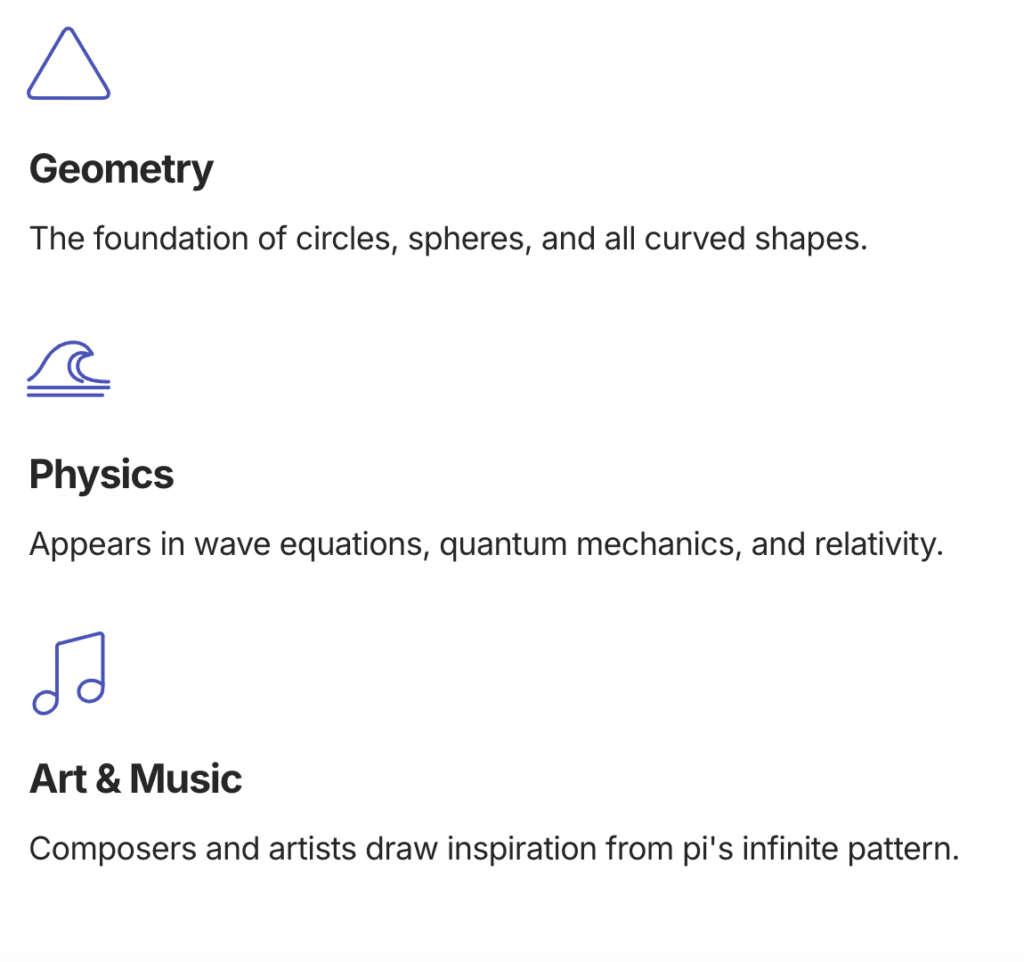
From ancient mathematicians scratching figures in sand to researchers pushing supercomputers to their limits, pi continues to captivate. It bridges geometry, calculus, probability, physics — and even art and music. Pi Day is a celebration not just of a number, but of the human drive to understand the elegant order underlying our universe.
Explore More Pi Day Resources 
Delve further into the fascinating world of Pi with these curated resources for all ages and interests, offering deeper insights and engaging activities for continuous learning and fun.

Official Pi Day Site
Discover official Pi Day celebrations, history, and activities from around the world. Visit PiDay.org

Educational Activities
Find lesson plans, worksheets, and interactive tools for teaching Pi concepts. Exploratorium’s Pi Activities

Fun Facts & Games
Explore trivia, mind-benders, and entertaining ways to celebrate Pi’s uniqueness. Math Is Fun – Pi

NASA Pi Day Challenge
Tackle real-world math problems inspired by NASA’s space exploration missions. JPL Pi Day Challenge
Access more Pi Day Resources here!
Embrace the Wonder! 
“Pure mathematics is, in its way, the poetry of logical ideas.” — Albert Einstein
This Pi Day, whether you’re measuring circles, cracking the 3-1-4 puzzle, writing pi-kus, or savoring a slice of pie — take a moment to marvel at π. It’s a reminder that mathematics is not just calculation; it’s a profound language describing the elegant, boundless mystery of our universe.
Happy Pi Day — 3.14159… and counting! 
Pi Day 2026: A Day to Remember
This year’s Pi Day was a true testament to the brilliance and compassion of my students, leaving me incredibly proud as I reflect on how they bridged the gap between logical mastery and meaningful impact. Through our dedicated participation in the St. Jude Math-a-Thon, these bright learners turned their mathematical skills into a force for good, successfully raising over $1,700 to support the life-saving mission of St. Jude Children’s Research Hospital. Their enthusiasm didn’t stop there; they also rose to the challenge of the NASA Receiver Riddle, expertly applying the constant of Pi to calculate the precise orbital distance required for the Psyche spacecraft to aim its laser. Watching them navigate both the complexities of space exploration and the simple power of charity has been a profound experience, proving once again that math is a tool not just for discovery, but for connection.
Pi reminds us that mathematics is not just about numbers, but about the elegant patterns, profound mysteries, and tangible good we can create in our world and beyond.
Cheers!
Comments
Post a Comment